Features and Benefits 
- IEEE 802.11a/b/g compliant
- Dual-RF design: 2.4 GHz and/or 5 GHz RF bands
- Supports 100 ms redundant roaming
- Compliant with essential sections of EN 50155
- Rugged IP68-rated housing and -40 to 75°C operating temperature
Introduction
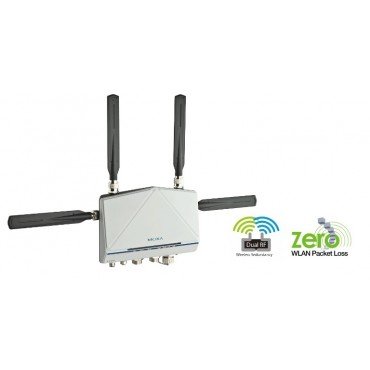
The AWK-6222 outdoor wireless AP/bridge/client avoids interruptions in WLAN transmissions with its dual 2.4/5 GHz RF modules, which allow two independent wireless connections over different frequencies. To maximize wireless and wired network availability, the AWK-6222 can incorporate Ethernet redundancy using RSTP, and power redundancy using dual DC power inputs and PoE. In addition, the AWK-6222 is housed in an IP68 metal casing with M12 connectors for total protection against dust, water, vibration, and other environmental effects. This rugged unit supports seamless roaming to achieve ultrareliable and redundant wireless networks under challenging outdoor, mobile conditions. These industrially hardened features let you set up a rock-solid WLAN to ensure that your entire network will always be in service. The AWK-6222 is compliant with the essential sections of EN 50155, covering operating temperature, power input voltage, surge, ESD and vibration.
Redundancy to Increase System Reliability
- PoE and dual DC power inputs
- Dual RF design with 2.4 or 5 GHz dual-band operation for redundant WLAN connections
- Redundant roaming for fast and stable handoff
- Ethernet redundancy via RSTP
Industrial and Outdoor Rated Features for Critical Environments
- IP68-rated metal housing and -40 to 75°C wide operating temperature
- Long-distance wireless transmission over 10 km
- Anti-vibration M12 design and waterproof/dust-tight RJ45 connectors
- Wall, DIN-Rail, and pole mounting options for versatile outdoor installation
| • WLAN Interface | |
| Standards | IEEE 802.11a/b/g for Wireless LAN IEEE 802.11i for Wireless Security IEEE 802.3 for 10BaseT(X) IEEE 802.3u for 100BaseT(X) IEEE 802.3af for Power-over-Ethernet IEEE 802.1D for Spanning Tree Protocol IEEE 802.1w for Rapid STP IEEE 802.1Q for VLAN |
| Spread Spectrum and Modulation (typical) | • DSSS with DBPSK, DQPSK, CCK • OFDM with BPSK, QPSK, 16QAM, 64QAM • 802.11b: CCK @ 11/5.5 Mbps, DQPSK @ 2 Mbps, DBPSK @ 11 Mbps • 802.11a/g: 64QAM @ 54/48 Mbps, 16QAM @ 36/24 Mbps, QPSK @ 18/12 Mbps, BPSK @ 9/6 Mbps |
| Operating Channels (central frequency) | US: 2.412 to 2.462 GHz (11 channels) 5.18 to 5.24 GHz (4 channels) EU: 2.412 to 2.472 GHz (13 channels) 5.18 to 5.24 GHz (4 channels) JP: 2.412 to 2.472 GHz (13 channels, OFDM) 2.412 to 2.484 GHz (14 channels, DSSS) 5.18 to 5.24 GHz (4 channels for W52) |
| Security | • SSID broadcast enable/disable • Firewall for MAC/IP/Protocol/Port-based filtering • 64-bit and 128-bit WEP encryption, WPA/WPA2 Personal and Enterprise (IEEE 802.1X/RADIUS, TKIP and AES) |
| Transmission Rates | 802.11b: 1, 2, 5.5, 11 Mbps 802.11a/g: 6, 9, 12, 18, 24, 36, 48, 54 Mbps |
| TX Transmit Power | 802.11b: Typ. 23±1.5 dBm @ 1 to 11 Mbps 802.11g: Typ. 20±1.5 dBm @ 6 to 24 Mbps, Typ. 19±1.5 dBm @ 36 Mbps, Typ. 18±1.5 dBm @ 48 Mbps, Typ. 17±1.5 dBm @ 54 Mbps 802.11a: Typ. 18±1.5 dBm @ 6 to 24 Mbps, Typ. 16±1.5 dBm @ 36 to 48 Mbps, Typ. 15±1.5 dBm @ 54 Mbps |
| RX Sensitivity | 802.11b: -97 dBm @ 1 Mbps, -94 dBm @ 2 Mbps, -92 dBm @ 5.5 Mbps, -90 dBm @ 11 Mbps 802.11g: -93 dBm @ 6 Mbps, -91 dBm @ 9 Mbps, -90 dBm @ 12 Mbps, -88 dBm @ 18 Mbps, -84 dBm @ 24 Mbps, -80 dBm @ 36 Mbps, -76 dBm @ 48 Mbps, -74 dBm @ 54 Mbps 802.11a: -90 dBm @ 6 Mbps, -89 dBm @ 9 Mbps, -89 dBm @ 12 Mbps, -85 dBm @ 18 Mbps, -83 dBm @ 24 Mbps, -79 dBm @ 36 Mbps, -75 dBm @ 48 Mbps, -74 dBm @ 54 Mbps |
| • Protocol Support | |
| General Protocols | Proxy ARP, DNS, HTTP, HTTPS, IP, ICMP, SNTP, TCP, UDP, RADIUS, SNMP, PPPoE, DHCP |
| AP-only Protocols | ARP, BOOTP, DHCP, STP/RSTP (IEEE 802.1D/w) |
| • Interface | |
| Default Antennas | 2 dual-band omni-directional antennas, 5 dBi at 2.4 GHz, 2 dBi at 5 GHz, N-type (male) |
| RJ45 Ports | 2, 10/100BaseT(X), auto negotiation speed, F/H duplex mode, and auto MDI/MDI-X connection |
| Connector for External Antennas | N-type (female) |
| Console Port | RS-232 (waterproof RJ45-type) |
| LED Indicators | PWR, FAULT, STATE, WLAN1, WLAN2, LAN1, LAN2 |
| Alarm Contact (digital output, M12 female connector) | 1 relay output with current carrying capacity of 1 A @ 24 VDC |
| Digital Inputs (M12 female connector) | 2 electrically isolated inputs • +13 to +30 V for state “1” • +3 to -30 V for state “0” • Max. input current: 8 mA |
| • Physical Characteristics | |
| Housing | Metal, IP68 protection |
| Weight | 1.8 kg |
| Dimensions | 224 x 147.7 x 64.5 mm (8.82 x 5.82 x 2.54 in) |
| Installation | Wall mounting (standard), DIN-Rail mounting (optional), pole mounting (optional) |
| • Environmental Limits | |
| Operating Temperature | -40 to 75°C (-40 to 167°F) |
| Storage Temperature | -40 to 85°C (-40 to 185°F) |
| Ambient Relative Humidity | 5% to 100% (non-condensing) |
| • Power Requirements | |
| Input Voltage | 12 to 48 VDC, redundant dual DC power inputs or 48 VDC Power-over-Ethernet (IEEE 802.3af compliant) *Compliant with EN 50155 on 24 VDC |
| Connector | M12 male connector with A-coding |
| Power Consumption | • 12 to 48 VDC, 1.066 to 0.312 A |
| Reverse Polarity Protection | Present |
| • Standards and Certifications | |
| Safety | UL 60950-1, EN 60950-1 |
| Hazardous Location | UL/cUL Class I Division 2, ATEX Zone 2 |
| EMC | EN 301 489-1/17, FCC Part 15 Subpart B, EN 55022/55024 |
| Radio | EN 300 328, EN 301 893, DSPR (Japan) |
| Rail Traffic | EN 50155, EN 50121-1/4 |
| • Reliability | |
| MTBF (mean time between failures) | 284,072 hrs |